The 4:22 time motif
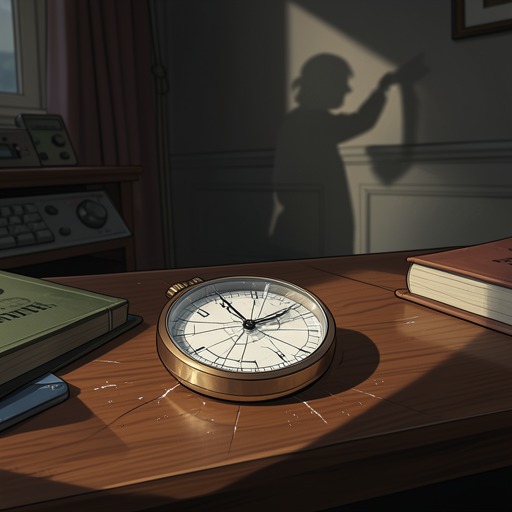
The IPCRESS FileThe 4:22 time motif turns a stopped wristwatch into a measure of the Unnamed narrator’s ordeal: first the time records a beating, then it persists through days of captivity and reappears as he struggles back to awareness. Its recurrence sets the broken object’s fixed time against a lived experience in which chronology and memory become increasingly difficult to distinguish.
The Watch and the Beating
The narrator remembers arriving in a room at 2:59 one night. At 3:40, a sergeant told him he need not keep looking at his watch because his companions were already gone. At 3:49, after the narrator had said “I don’t know” 200 times, the sergeant hit him. The beating continued until he was hurt enough to want to tell the interrogator something. When the narrator looks at his watch again, it reads 4:22: it has stopped and is smashed. The exact sequence gives the time its first force—not as a neutral clock reading, but as a marker pinned to an episode of coercion and pain.
Time Under Captivity
During the days that follow, the narrator describes time as clotted together into an inseparable mess. The fluorescent-lit days are punctuated by interrogations; medical examinations, interviews, IQ and coordination tests, hot lights, and cold showers blur into a month. His surroundings and routine offer few distinctions by which to measure ordinary time. Guards sometimes give him the time, but mostly say it has just turned 4:20, a repeated report that sits close to, but does not dislodge, the watch’s fixed 4:22.
That discrepancy sharpens the motif’s effect. The guards’ announcements suggest the institutional routine continues to mark passing minutes, while the narrator’s smashed watch remains stopped. In the same period, he says he ceased to remember that Jean or Dalby existed and sometimes doubted his own existence. The loss of personal memory and the repetition of an almost identical time reading make captivity feel less like a sequence of days than a condition from which ordinary chronology has drained away.
Return of the Fixed Time
The reading returns when the narrator slowly becomes sentient again. Hugging close to damp soil, he inspects the broken wristwatch by the light of a small window and finds that it still says 4:22. Nearby voices are only groans. He is weak, disoriented, and intermittently asleep; the repeated time is therefore not evidence that time itself has stopped, but a concrete remnant carried through his damaged awareness.
The narrator’s concise declaration, “I hurt, therefore I am,” places bodily sensation at the center of this return. The watch’s unchanged reading gives that pain a recurring temporal form: 4:22 first accompanies the beating, persists as the narrator’s days collapse together, and is present again as consciousness returns. The motif binds those scenes without resolving their disorientation, making the broken watch both a physical object and a record of how captivity has fractured the narrator’s experience of time.